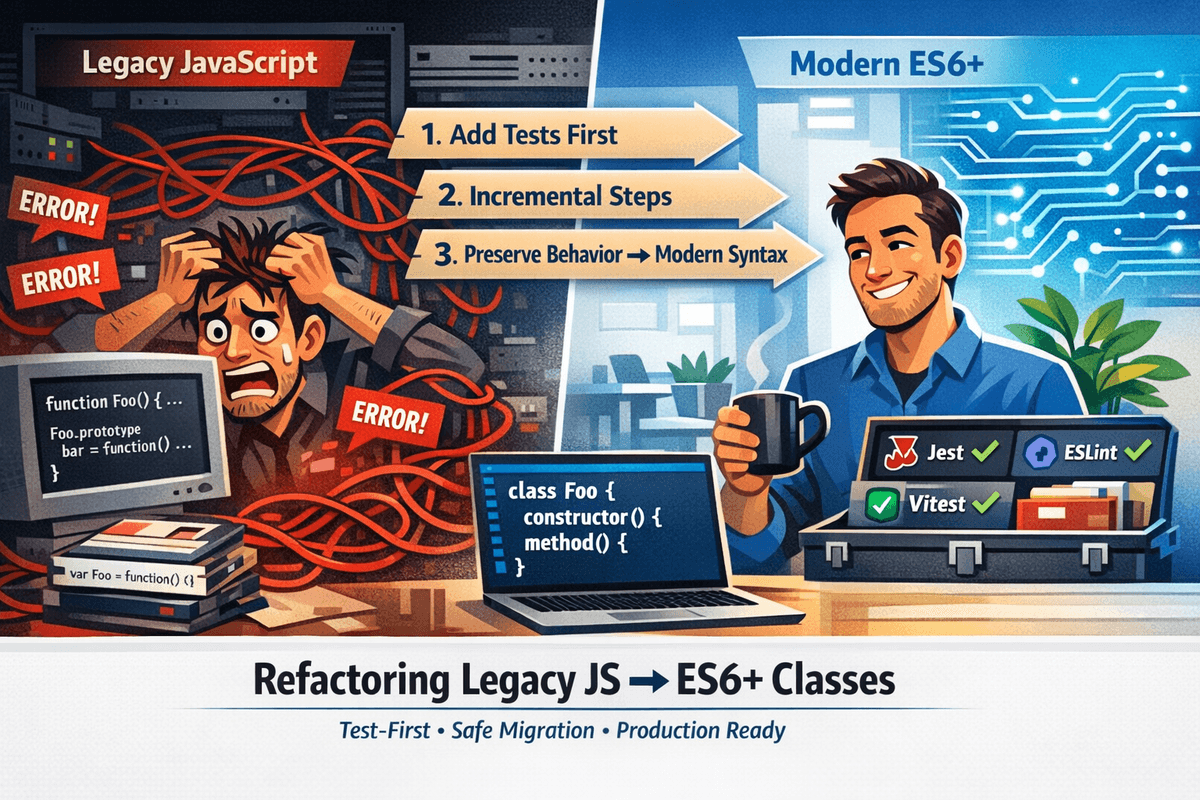
Refactoring Legacy JavaScript to ES6+ Classes (Without Breaking Everything)
February 11, 2026 · 7 min read
JavascriptSoftware DevelopmentCareer Tips
If you’ve ever opened an old JavaScript file full of constructor functions and prototype chains, you know the feeling. It works… but it feels fragile, hard to read, and painful to extend. Refactoring legacy procedural JavaScript (pre-ES6 patterns) into modern ES6+ classes can dramatically improve readability, maintainability, and IDE support without changing behavior. The key? Move carefully. Test everything. Change structure, not logic.
Step 1: Protect the Existing Behavior
Before touching the code, write tests. Legacy JavaScript often has little to no test coverage. Start by “characterizing” the current behavior: record inputs, outputs, edge cases, and instance behavior. Use Jest or Vitest to create a safety net.
For complex object outputs, consider:
- Snapshot testing
- Approval testing
Sometimes, capturing entire object states and diffing them is safer than writing dozens of granular assertions, especially in poorly documented systems. Your goal isn’t perfect architecture yet. It’s preventing regressions.
Step 2: Understand the Structure
Look for:
- Constructor functions
- prototype. method definitions
- Inheritance via {Object.create}
- Manual constructor reassignment
- Shared state through globals
- Immediately-invoked constructor patterns (new function() {})
Understanding the prototype chain is critical before replacing it with class and extends.
**Hoisting Gotcha : -
Constructor functions are hoisted.
Class declarations are not.
If legacy code calls a constructor before its definition in the file, converting it directly to a class will break execution. A simple reorder can prevent subtle runtime errors.
Step 3: Refactor Incrementally
Don’t rewrite everything. Instead:
- Extract one constructor module
- Add or confirm tests
- Wrap it in a class shell
- Move prototype methods inside the class
- Replace inheritance with extends
- Run tests
Small, safe steps beat big rewrites every time.
**Mapping Legacy Patterns to Modern Classes :-
Here’s how common patterns translate:
- "function Foo() {} + Foo.prototype.method = …" → "class Foo { method() {} }"
- "Foo.prototype = Object.create(Bar.prototype)" → "class Foo extends Bar {}"
- "var thing = new function() { ... }" → Plain object literal, or singleton class instance (if instanceof matters)
- Factory functions returning objects → Static methods like static create()
- Shared mutable globals → Encapsulated state or private fields (#field) when appropriate
Classes eliminate manual prototype manipulation and make inheritance cleaner and easier to reason about.
**Best Practices (and Pitfalls) :-
Always preserve behavior.
Watch for differences in instanceof, constructor behavior, and prototype checks.
Be careful with method binding.
Legacy code often relies on patterns like:
- setTimeout(obj.method.bind(obj), 100)
- Class methods are not auto-bound. If the original relied on .bind() or .call(), you’ll need to bind explicitly in the constructor or use arrow functions intentionally.
- Call super() in subclasses.
Forgetting this breaks everything fast.
- Don’t over-engineer.
Resist the urge to add getters/setters everywhere just because you can. If public properties worked before, keep them public. Refactoring is not redesign.
- Use tooling but review manually.
ESLint rules like 'prefer-class', 'no-prototype-builtins', and 'class-methods-use-this' can flag legacy patterns. Codemods and AI tools can help with mechanical transformations, but you are responsible for correctness.
Performance differences between constructor functions and classes are negligible in real-world apps. Focus on clarity, not micro-optimization.
**Why This Matters?
Refactoring to ES6+ classes isn’t just about modern syntax. It improves:
- Code readability
-Team collaboration
-IDE autocomplete and static analysis
-TypeScript compatibility
-Long-term maintainability
Done incrementally and test-first, this migration strengthens your codebase without disrupting production. Modernizing legacy JavaScript doesn’t require a rewrite. It requires discipline and patience.